


When my colleagues and I talk about massive, hyperscale data centers, we use a kind of shorthand to capture the national feeling around extractive AI factories: Everyone hates data centers.
This week, voters confirmed that sentiment pretty much anywhere data centers or their backers were on the ballot.
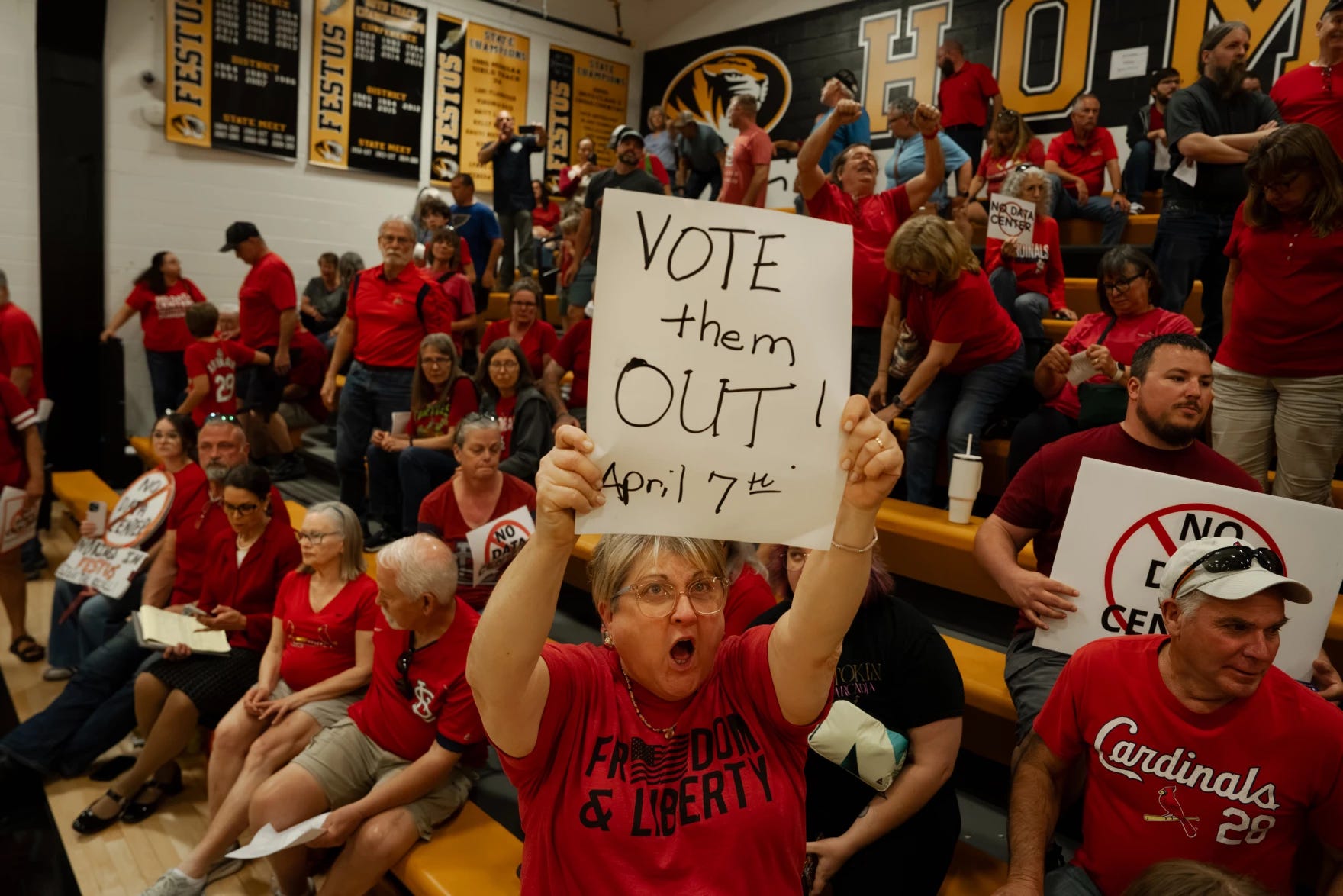
Let’s start in my neck of the woods, in Festus, Missouri, a Mississippi River town just south of St. Louis. Last week, the eight-member Festus city council sat at a table at one end of the Festus High School gymnasium to hear public comment and vote on an ordinance that would permit a new $6 billion data center in town. The data center plan was massively unpopular among residents, who filled the rafters of the gym and, one by one, walked to the lectern at center court to berate the plan, and the council, for even considering it (until the mayor of Festus, Sam Richards, cut off speakers two hours into the meeting). In a scene both remarkable and predictable, Festus residents booed, jeered, and chanted “vote them out” as the council voted to approve the ordinance, 6-2.
Well, as the saying goes: Play stupid games, win stupid prizes. Four members of the council who supported the data center were up for reelection on Tuesday, and every member lost by margins that don’t do justice to the word, “landslide.” Council member Bobby Venz barely won 17 percent of the vote in his race. Seventeen! Jim Tinnin, who also voted for the data center ordinance, failed to get 20 percent of the votes in his race. All four newly-elected council members ran on platforms of government transparency and against data centers, and they all won handily. In Festus — as with the rest of the country — elected officials only get to support data centers once.
A few hundred miles north, in the Milwaukee, Wisconsin suburb of Port Washington, residents have been grappling with a massive, $15 billion data center project intended to host OpenAI servers as part of the Trump-backed, nation-wide “Stargate” data center roll out. Folks in Port Washington didn’t want it, and certainly didn’t want it if it meant the city was going to give away millions in tax revenue to help some of the wealthiest companies on earth build it. Data centers have flocked to the southeast corner of Wisconsin, surely attracted by easy access to the copious amounts of fresh water required to run the AI factories. So through a voter-led, citywide ordinance, residents offered up an ultimatum: If Big Tech wants to build data centers here, they — and not taxpayers — will have to pay for it.
The ordinance, which would let voters approve or deny tax incentives for any project worth more than $10 million, went before voters on Tuesday and passed by about a 2-to-1 margin. Christine Le Jeune, who leads the grassroots group Great Lakes Neighbors United, told Politico on Tuesday that the vote sets a precedent for data center fights around the country. “This is something that other communities can look to,” she said.
These fights are just the start. Voters in three other towns will take up similar ordinances later this year, while Ohio residents are working to get a state-wide data center moratorium on the ballot in November. And that feels like just the tip of a much larger anti-data center iceberg that is emerging as one of, if not the driving force in local politics. Residents in Williamstown, New Jersey recently berated their city council members over their data center support (and the council’s apparent annoyance at their constituents’ concerns). Nationwide, half of all planned data centers have been delayed or cancelled, almost entirely due to the organized opposition of local groups. The national rejection of data centers is more bipartisan than any other issue in American politics. National left-leaning democrats Bernie Sanders and Alexandria Ocasio-Cortez are pushing a nationwide data center moritorium, while Ohio Lt. Governor candidate Kim Georgeton, a republican and self-proclaimed “constitutional conservative,” has made opposing data centers a key plank in her platform for office. Again: Everyone hates data centers.
A good portion of this visceral, near-universal reaction to data centers and AI is indeed a kind of NIMBYism, what I would call monopoly NIMBYism. Data centers are bad neighbors. Their excessive energy use drives up electricity bills. They are impossibly thirsty, requiring millions of gallons of fresh water to operate. They’re noisy. They pollute the air and water. Not wanting the worst possible neighbor to move in next door is an imminently reasonable position for people to take. But the data center uprising isn’t just about the physical thing. People’s apprehension of data centers mirrors our collective apprehension of AI, and of big tech in general. One of AI proponents’ main selling points is that AI is going to render some kinds of jobs unnecessary — a frightening prospect for many service workers, particularly in Rust Belt communities where good paying, union factory jobs left decades ago. Aside from a few hundred construction jobs during buildout, AI data centers don’t create jobs; they take them. The data center problem smacks of broader pattern of big tech monopolies making local residents’ lives worse — how Google’s advertising monopoly has decimated local newspapers, and how Amazon has tried to kill off whatever local brick-and-mortar retailers Walmart didn’t destroy over the past 30 years. People are fighting Amazon warehouses and dollar stores in the same ways and for the same reasons they fight data centers: No one wants an extractive monopoly outpost in their back yard. And when voters get the chance to go to the polls to show their opposition, they do it.
I'm especially proud of Festus. Relatives and friends lived there, and I've visited the town a couple times. It was a declining town back then, and declining towns are vulnerable to fraudsters like Altman.
I’m not seeing the opposition to Amazon warehouses that I’m seeing with data centers. Friends and family members who lean liberal to progressive continue to support Amazon, despite my efforts to explain to them why they should boycott the company. Even worse are the economic developers providing massive tax breaks to Amazon. 😒