


Some folks who work in the antitrust and antimonopoly space often go to lengths to convince their opponents and the broader public that they aren’t actually opposed to corporate bigness. What they’re opposed to, they’ll say, is the abuse of the power that so often emanates from corporate bigness.
A few different kinds of policy advocates I come across share this view. Some activists say this because they believe it in a literal sense: That big corporations aren’t the problem; it’s the bad things big corporations do that cause all the trouble, and we’ll be ok if we can somehow stop them from doing bad things. Others defend corporate bigness because they’re trying to defang their opposition (which is usually made up of those same big businesses and their supporters), seem reasonable, or conform to the current state of antitrust law, in which monopolizing an industry isn’t illegal. Still others believe that big companies confer some benefits to the world, either because they create so-called “economic efficiency,” or, for some in the labor movement, because organizing employees at big companies delivers more benefits to more workers than trying to organize employees at a bunch of small businesses.
I have no doubt that all of these arguments nominally supportive, or at least accepting, of corporate bigness are earnest and well-intended. I understand the benefits of network effects, where more users of a product or platform make using the thing functionally better, and I get that some kinds of infrastructure are probably best left whole and brought under democratic control through other means. But these are arguments I hear about private monopoly from allies and friends in the antimonopoly movement. They are valid arguments, certainly within the policy confines within which my colleagues operate.
I hear those arguments. I just don’t believe them.
If we as a country and society continue to allow corporations to grow unaccountably large, those corporations will hasten the end of the American democratic experiment as we know it.
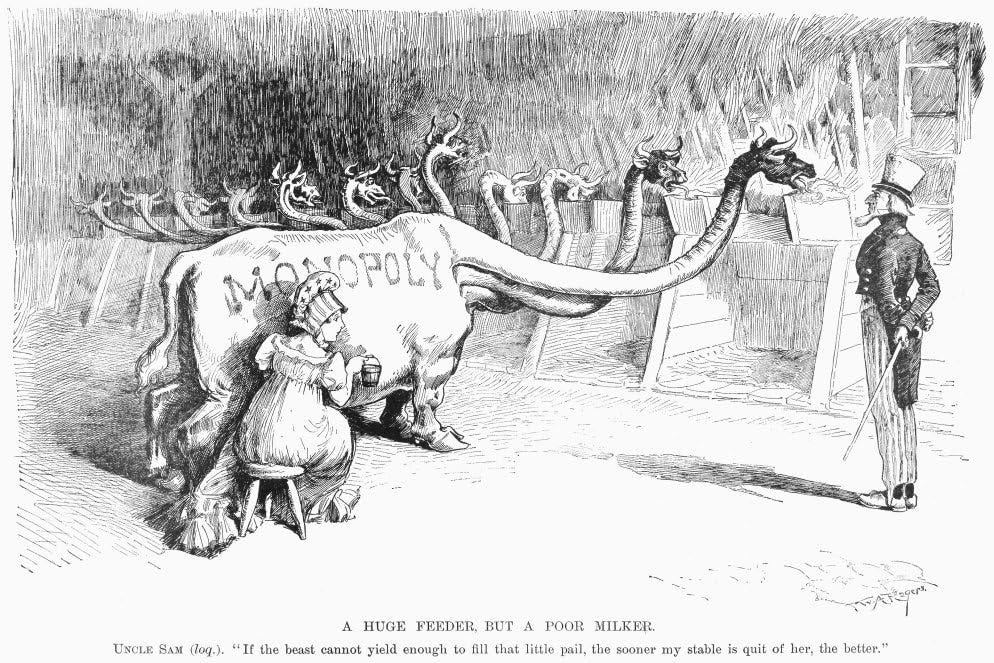
To anyone who asks my view of corporate bigness, I say very proudly that I am a monopoly abolitionist. I believe that whatever supposed benefits bigness might create for society, be it economies of scale, benefits to workers, or what have you, are more than offset by the grave and existential threat corporate bigness poses to our economy, politics, and democracy. For any notch corporate bigness adds to the “pros” column, it adds another ten notches to the column marked “cons,” to the point that, if we as a country and society continue to allow corporations to grow unaccountably large, those corporations will hasten the end of the American democratic experiment as we know it.
I didn’t reach this conclusion based on vibes or some ideological take that “big is bad.” This also isn’t a simple parroting of Justice Louis Brandeis — and, after him, former Biden administration official and author Tim Wu — when he spoke of “the curse of bigness” (although both men were correct in their critique of corporate power). I believe monopolies are irredeemable and counter to democracy because, as a researcher and writer, I’ve engrossed myself in the history of corporate power in America and found that monopolies have been most the consistent threat to and enemy of democracy since pretty much the beginning.
For the past several months, I’ve been researching and writing an essay examining the connection between corporate monopolies and the Nazi regime before and during World War II, and reflecting on what that connection means for America today. While the research centered on Germany and how Hitler leveraged its industrial giants to wage war on Europe, countless paths in my research led me back to America. Before, during, and after the rise and fall of Nazi Germany, American monopolies and corporate giants worked quietly to undermine democracy at home and support fascism in both name and nature. Some of the stories I found were telling of monopoly’s true allegiances, like when prominent American business leaders praised Italian fascism under Mussolini, for example. Others were far more insidious, like when a group of Wall Street bankers and corporate executives schemed to overthrow Franklin Roosevelt’s administration and replace him with an authoritarian. There were simply too many examples of American monopolists’ love affair with fascism to fit in the essay. Over the next few weeks, I plan to tell those stories here (or re-tell stories from the brilliant researchers and writers who first unearthed them), likely in a kind of mini-series within Who Shall Rule.
I left my research with an even clearer belief that concentrated corporate power is fully incompatible with democracy; as Brandeis said, we can have one or the other, but not both. I’m far from the first to make this observation. But understanding the close relationship between monopoly and authoritarianism feels so incredibly urgent today, as our current federal government increasingly relies on big business to carry out its authoritarian work.
Since the dawn of the industrial age, the American public has spent an immeasurable amount of time and resources trying to hold back corporate power. Every law, regulation, study, lawsuit, criminal case, and pocket of government bureaucracy aimed at restraining corporations is almost entirely because of, and a way to try to solve for, the natural tendencies of corporate bigness.

The famous statutes outside of the Federal Trade Commission building, entitled “Man Controlling Trade,” depict a man attempting to restrain a brutal, muscular horse doing all it can to break free of his grasp. If this is the visual representation of the purpose of our antimonopoly laws and the enormous force required to enforce them, it begs the question: Why do we let the proverbial horse exist in the first place?
The answer is that, technically, we don’t. The Sherman Act of 1890, the country’s first antitrust law, says by the letter that monopolies are illegal. The law says, in plain English: “Every person who shall monopolize, or attempt to monopolize, or combine or conspire with any other person or persons, to monopolize any part of the trade or commerce among the several States, or with foreign nations, shall be deemed guilty…” The law is clear: Monopolies are illegal. As my friend and antitrust scholar Robert Lande points out, “There is nothing in the statute, no language in [the law], that requires anticompetitive conduct. No words carve out an exception for a monopoly that can demonstrate itself to be efficient.”
The law wasn’t very effective in the years after it passed, so policymakers continued trying to figure out ways to stop monopolies from existing. By 1908, the Democratic Party platform pledged to persue “additional legislation as may be necessary to make it impossible for a private monopoly to exist in the United States.” Congress did in fact pass a new law, called the Clayton Act, in 1914 in the hopes it might finally stop monopolies from forming in the first place. The law bans all mergers that may tend to create a monopoly — not mergers that will or are even likely to lead to monopolization, as Lande points out. The dangers of monopolies were believed to be too great to risk allowing a corporate merger to create one. Even the possibility that a merger might tilt an industry toward monopoly was too much. That is the actual context of our antitrust laws.
The driving sentiment behind these efforts to legislate away monopolies wasn’t based on how monopolies actually behaved, although there was ample evidence that monopolies kneecapped competition, and ripped off farmers and shoppers — the Standard Oil case is just one example. Americans tried to stop monopolies from existing largely because we recognized the danger they posed, by their very nature, to our economic and political liberty. Dick Thompson Morgan, an Oklahoma congressman who was key to creating the Federal Trade Commission, wrestled with what to do with monopolies but ultimately landed on abolition. “I do not believe in regulating monopoly,” Morgan said during a congressional debate over creating the commission. “I do not believe in any complete monopoly.”
In the intervening years, lawmakers and law enforcers weakened their stance on monopoly power and agreed, with various degrees of reluctance, to allow monopolies to live among us. There are a host of complicated reasons for that: the Supreme Court’s decision in the Standard Oil case that restrained enforcement; the corporate bigness required to wage two world wars; the specter of communism pushing policymakers to embrace global markets and international trade; and the endurance of New Deal policies that brought balance to the economy and restrained corporate power.
The New Deal’s antimonopoly program endured in part because of the lessons Nazi Germany taught us. I write about this in my essay, as has University of Michigan professor Daniel Crane, but the collaboration between the Nazis and German industrial monopolies led American policymakers to a decades-long obsession with combatting corporate bigness — a movement called “structuralism,” in which the structure of a company determined the likelihood of it threatening competition, workers, and communities. By the 1970s, there were multiple efforts underway, both legislative and administrative, to break up monopolies simply because they were too large to exist in a democratic society.
There’s neither time nor space to tell the full story of how monopolies rose to reclaim power and erase our collective memories of the dangers of concentrated corporations. But they did, they have, and over the past half-century pro-monopoly policymakers have managed to weaken or undo nearly every means of control we once used to constrain monopolies — strong unions, antitrust action, local control, robust competition. That’s by the monopolies’ own design.
We allow monopolies to exist, so of course the people in charge of those businesses and their shareholders constantly hunt for ways escape their restraints. They use their vast wealth and power to buy teams of lawyers and economists to gum up any court case brought against them, and to tilt the law in their favor. They court favor with politicians tasked with watchdogging their industries and writing laws, in the hopes of loosening their constraints by means of statute or lax oversight. They push for the overturn of labor law, the outsourcing of jobs under the guise of “free trade,” the weakening of environmental regulation, and, perhaps most importantly, the end of antitrust.
All of these individual efforts at subverting any restraint on their power invariably lead the executives in charge of monopolies to search for a form of government that shares their economic and political goals. Why fight all of these disparate attempts to constrain them, when instead monopolists could support a politics that lets them do as they please? For the monopolist, authoritarianism is an attractive option. A corporation cornering an industry through mergers, or the private equity-led roll-up of a market, is the economic equivalent of a dictator’s march across a continent, subsuming anything that stands in the way of total power. The aims of both monopoly and authoritarianism are the same: Dominance, unquestioned rule, and brutal extraction. Monopolies love fascism because they ultimately have the same worldview, and work towards the same ends.
In the coming weeks, I’ll tell more of the stories of monopoly’s love affair with fascism and authoritarianism here. Maybe it’s the research fresh in my mind, or maybe it’s the state of the world around me, but to me, this is an existential question. Solving America’s monopoly problem in a lasting, structural way has never felt more urgent.
This is phenomenal and so refreshing. Thank you for your boldness. Can't wait for the rest of the series.
Very interesting! I look forward to your essay.